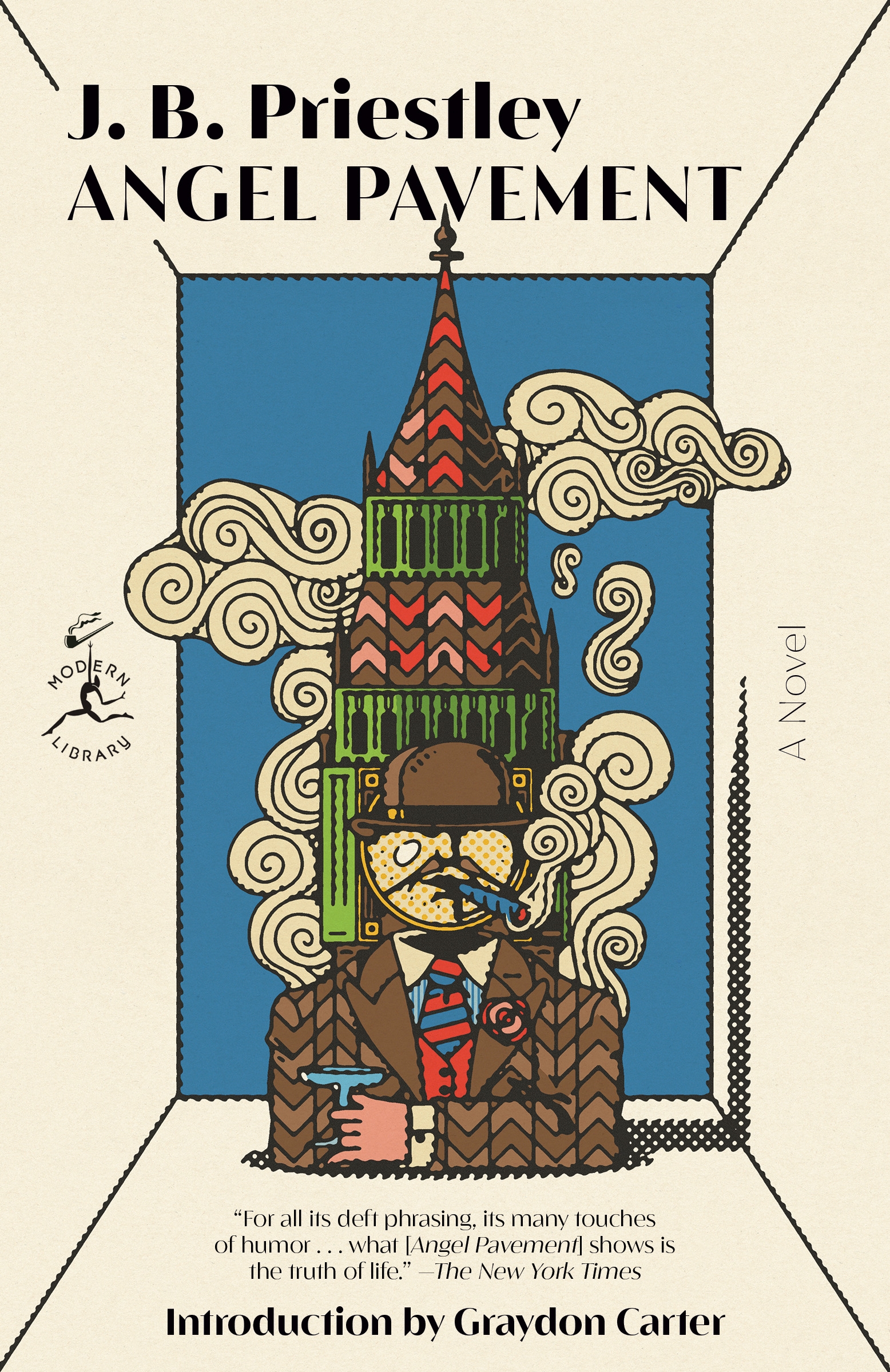
The struggling firm of Twigg & Dersingham is brought to riches—and ruin—in this kaleidoscopic portrait of late 1920s London from one of the twentieth century’s great, underappreciated masters.
On a grim sidestreet of the City of London called Angel Pavement, the office of Twigg & Dersingham carries out its day-to-day operations far from the decadence of the Roaring Twenties. The firm is now run, less than competently, by the nephew of the original Dersingham; to cut costs, he knows he must fire one of his few employees to have any hope of keeping the business afloat. Longtime head clerk Mr. Smeeth is desperate to not lose his job, but Mr. Dersingham really has his eye on junior clerk Mr. Turgis—awkward, unfashionable, and convinced that he’s about to stumble upon the love of his life—or typist Ms. Matfield, who left her home in the suburbs to live as a modern woman in the city, and who now wonders whether there’s more to modern life than this.
Enter the Golspies. When Mr. Golspie appears at the office on Angel Pavement from whereabouts unknown, his beautiful daughter Lena at his side, he presents a business proposition that Mr. Dersingham feels sure will save them. But of course, offers that seem too good to be true often are—and this one will set the firm and each of its employees on a course for disaster.
First published in 1930, Angel Pavement is a sweeping London novel in the vein of Dickens, Thackeray, Wolfe, and Amis, populated by a cast of richly developed characters and gilded by J. B. Priestley’s deft wit, which feels startlingly fresh in our own rapidly changing world.
J.B. Priestley, the son of a schoolmaster, was born in Bradford in 1894. After leaving Belle Vue High School, he spent some time as a junior clerk in a wool office. (A lively account of his life at this period may be found in his volume of reminiscences, Margin Released.) He joined the army in 1914, and in 1919, on receiving an ox-officers' grant, went to Trinity Hall, Cambridge. In 1922, after refusing several academic posts, and having already published one book and contributed critical articles and essays to various reviews, he went to London. There he soon made a reputation as an essayist and critic. he began writing novels, and with his third and fourth novels, The Good Companions and Angel Pavement, he scored a great success and established an international reputation. This was enlarged by the plays he wrote in the 1930s and 1940s, some of these, notably Dangerous Corner, Time and the Conways and An Inspector Calls, having been translated and produced all over the world. During the Second World War he was exceedingly popular as a broadcaster. Since the war his most important novels have been Bright Day, Festival at Farbridge, Lost Empires and The Image Men, and his more ambitious literary and social criticism can be found in Literature and Western Man, Man and Time and Journey Down a Rainbow, which he wrote with his wife, Jacquetta Hawkes, a distinguished archaeologist and a well-established writer herself. It was in this last book that Priestley coined the term 'Admass', now in common use. Among his latest books are Victoria's Heydey (1972), Over the Long High Wall (1972), The English (1973), Outcries and Asides, a collection of essays (1974), A Visit to New Zealand (1974), The Carfitt Crisis (1975), Particular Pleasures (1975), Found, Lost, Found, or the English Way of Life (1976), The Happy Dream (1976), English Humour (1976) and an autobiography, Instead of the Trees (1977). In 1977 J. B. Priestley received the Order of merit. He died in 1984.
“For all its deft phrasing, its many touches of humor . . . what [Angel Pavement] shows is the truth of life.” —New York Times
“The whole fabric of the few lives, are opened up to us with a warm and generous assiduity that is entirely convincing. . . . Magnificent.” —The Times
“Brings into focus vast sections of London. . . . Mr. Priestley is a master of the phrase which sets off a person or a scene in all its pathetic absurdity.” —The Atlantic
Our top books, exclusive content and competitions. Straight to your inbox.
Thank you! Please check your inbox and confirm your email address to finish signing up.