> Skip to content
[]
  • Published: 16 December 2025
  • ISBN: 9781506749600
  • Imprint: Dark Horse Books
  • Format: Paperback
  • Pages: 528
  • RRP: $95.00

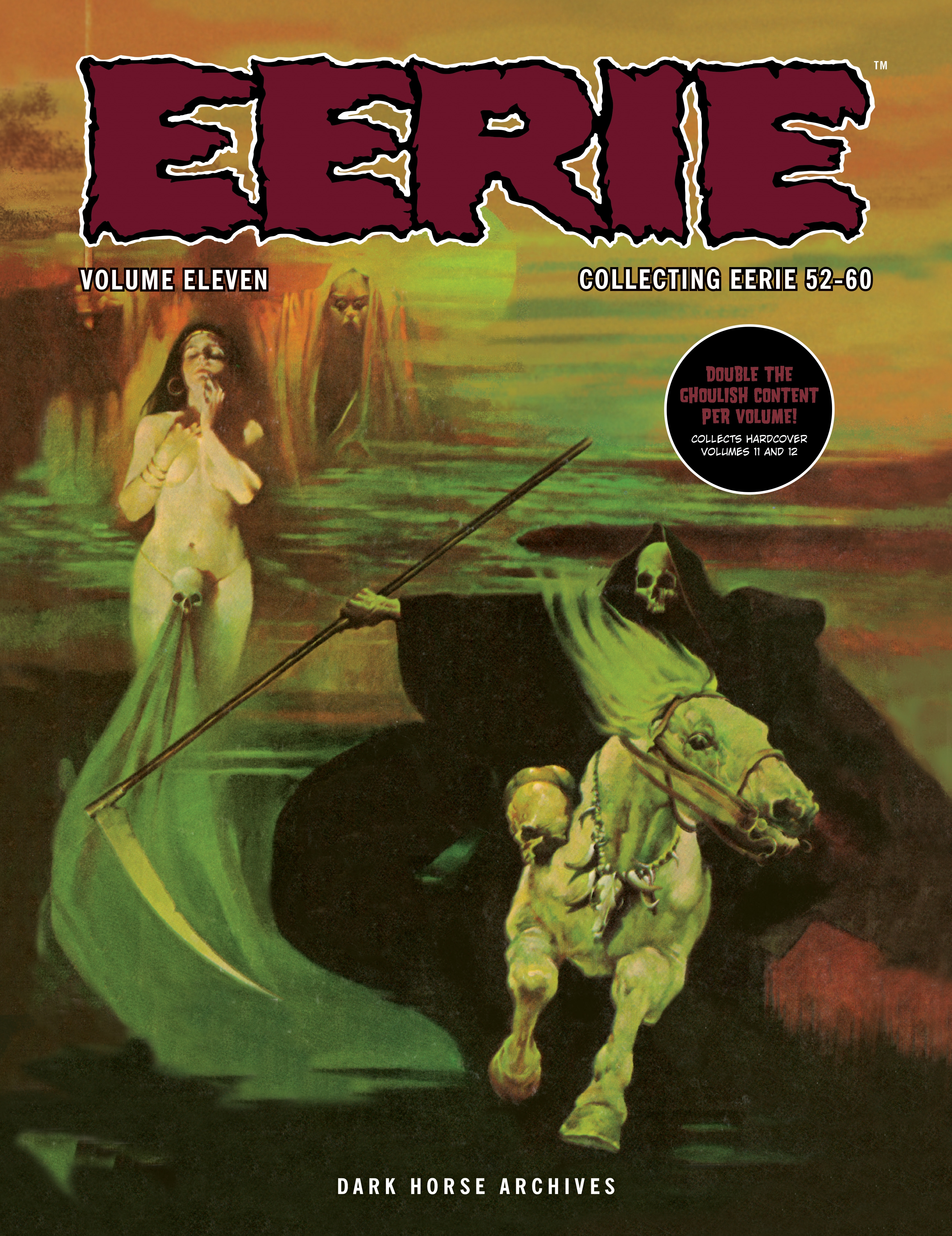
Eerie Archives Volume 11 (Double-Sized Volume)


A DOUBLE SHOT OF TERROR—TWO HORRIFYING VOLUMES IN ONE!

LEGENDARY CREATORS OF LEGENDARY TERROR!

A DOUBLE SHOT OF TERROR—TWO HORRIFYING VOLUMES IN ONE!

LEGENDARY CREATORS OF LEGENDARY TERROR!

Now in a packed-full double volume with twice as many ghoulish stories, previously collected in Dark Horse's hardcover volumes 11 and 12. 

Collecting eight full issues of Warren Publishing's legendary Eerie horror anthology and nine covers, this double volume paperback edition features the inimitable art of the legendary Bernie Wrightson, Richard Corben, Wally Wood, Will Eisner, and more!

Crack open this tome to read Esteban Maroto’s enchanting tales of Dax the Warrior, the explosive introduction of the Hunter the demon killer of the future, a run of breathtaking covers by Sanjulian and Ken Kelly and a do-it-yourself Werewolf! board game top off this fine collection of 1970s horror tales!

Collects Eerie magazine #52–#58 and #60, and the cover for Eerie #59, a reprint issue of Dax the Damned stories that were collected in past Eerie Archives volumes.
  • Published: 16 December 2025
  • ISBN: 9781506749600
  • Imprint: Dark Horse Books
  • Format: Paperback
  • Pages: 528
  • RRP: $95.00

About the authors

Will Eisner

Will Eisner (1917–2005) was a writer, creator, and one of the true legends in the comic book medium. Eisner is the creator of The Spirit, one of the first comic properties to gain widespread popularity and acclaim. One of the biggest awards in the comic book industry is the Eisner award, named after the Brooklyn-born legend.

Doug Moench

Doug Moench has written novels, short stories, newspaper feature articles, weekly newspaper comic strips, film screenplays, and teleplays. His first published work was My Dog Sandy, a comic strip printed in his elementary school newspaper. Moench has worked for DC Comics, Marvel Comics, Dark Horse Comics and many other smaller companies; he has written hundreds of issues of many different comics, and created dozens of characters, such as Moon Knight.

Neal Adams

Neal Adams was born June 6, 1941 in New York City. He attended Manhattan's High School of Industrial Art and, while still a student, found work ghosting the Bat Masterson syndicated newspaper strip and drawing gag cartoons for Archie Comics. Neal received his own comic strip based on the popular TV series Ben Casey in 1962. The strip ran until 1965 at which time Neal made the move to comics for Warren Publishing and DC Comics. Neal's realistic style on Deadman and Green Lantern/Green Arrow, at odds with the more cartoony comics of the day, made him an immediate star. He became DC's premier cover artist, contributing radical and dynamic illustrations to virtually the company's entire line. Neal's work has also appeared in Marvel's X-Men, The Avengers, and Thor, on paperback book covers, and on stage, as the art director for the Broadway science fiction play, Warp. In the 1970s, Neal and partner (and frequent inker) Dick Giordano started the art agency Continuity Associates out of which came, in the 1980s, Continuity Comics. Neal is the winner of several Alley, Shazam, and Inkpot Awards, and was inducted into the Harvey Awards' Jack Kirby Hall of Fame in 1999.

Richard Corben

Richard Corben was born on a farm in Anderson, Missouri, and went on to get a bachelor of fine arts degree from the Kansas City Art Institute in 1965. After working as a professional animator, Corben started doing underground comics, including Grim Wit, Slow Death, Skull, Rowlf, Fever Dreams, and his own anthology Fantagor. In 1970 he began illustrating horror and science-fiction stories for Warren Publishing. His stories appeared in Creepy, Eerie, Vampirella, 1984, and Comix International. He also colored several episodes of Will Eisner's Spirit. In 1975, when Mœbius, Druillet, and Jean-Pierre Dionnet started publishing the magazine Métal Hurlant in France, Corben submitted some of his stories to them. He continued his work for the franchise in America, where the magazine was called Heavy Metal. In 1976 he adapted a short Robert E. Howard story in Bloodstar. In 2012 he was elected to the Will Eisner Award Hall of Fame.

Praise for Eerie Archives Volume 11 (Double-Sized Volume)

“The lineup of creators who worked on both Creepy and Eerie reads like a list of some of comics’ greatest horror cartoonists.”—The Gutter Review