> Skip to content
[]
  • Published: 16 May 2002
  • ISBN: 9780451523631
  • Imprint: Signet
  • Format: Paperback
  • Pages: 736
  • RRP: $24.99

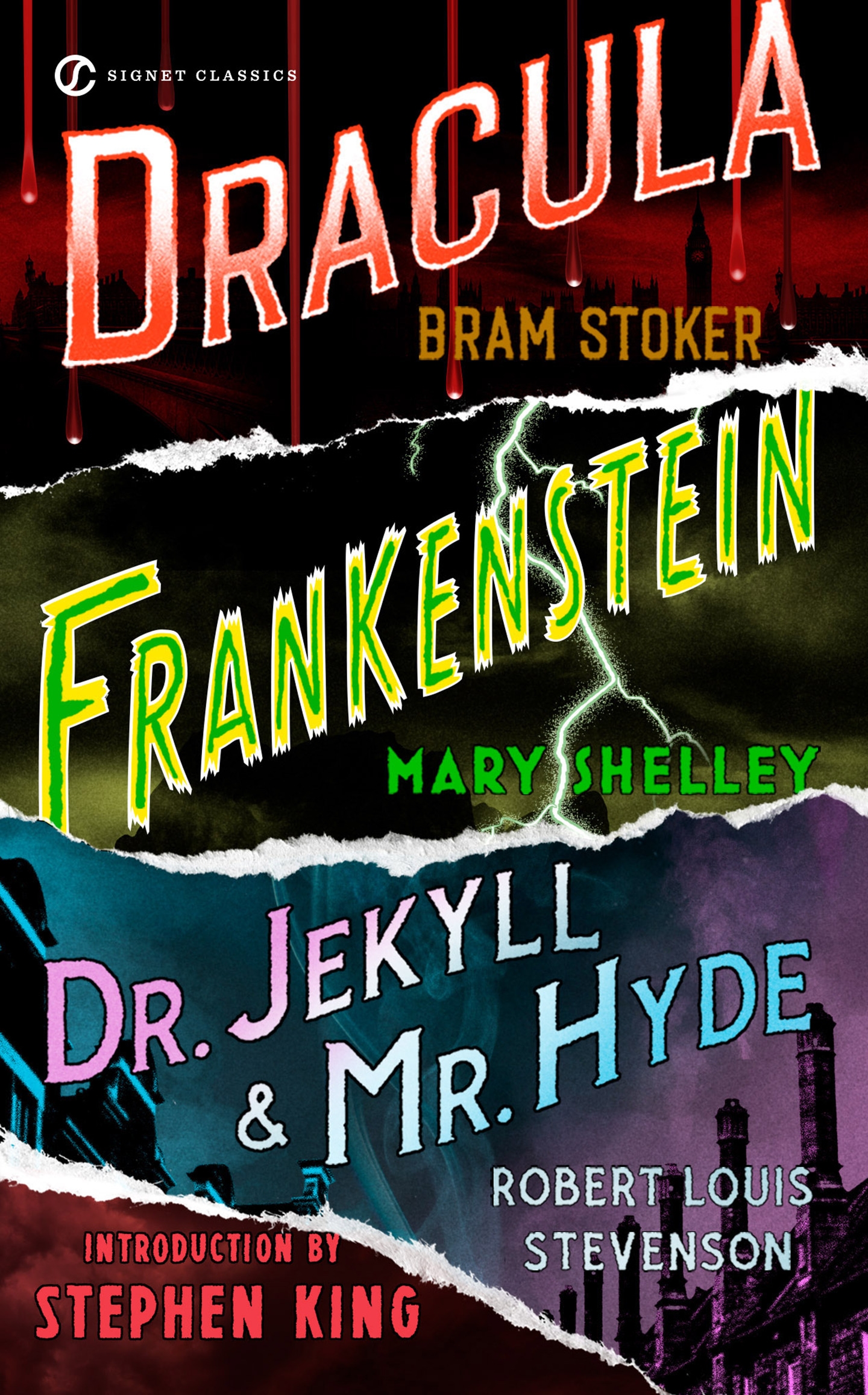
Frankenstein, Dracula, Dr. Jekyll and Mr. Hyde


Three horror icons come together in one indispensable tome—with an introduction by Stephen King.

“Within the pages of this volume you will come upon three of the darkest creations of English nineteenth-century literature; three of the darkest in all of English and American literature, many would say…and not without justification…These three creatures, presented together for the first time, all have a great deal in common beyond their power to go on frightening generation after generation of readers…but that fact alone should be considered before all others.”—From the Introduction by Stephen King

A diabolical, bloodthirsty Count draws an unsuspecting young man into a world of terrors. A scientist oversteps the bounds of conscience and brings to life a tortured creation. A man of medicine explores his darker side only to fall prey to it. These three legendary tales have held readers spellbound for more than a century. 

The titles alone—Dracula, Frankenstein, and Dr. Jekyll and Mr. Hyde—have become synonymous with horror. They are part of a universal language that serves to put a monster’s face on the good-and-evil duality of our very human nature. Inventive and subversive, these classic tales of terror can shake even the modern reader with something far more profound than fear....
  • Published: 16 May 2002
  • ISBN: 9780451523631
  • Imprint: Signet
  • Format: Paperback
  • Pages: 736
  • RRP: $24.99

About the authors

Bram Stoker

Abraham 'Bram' Stoker (1847-1912) was educated at Trinity College, Dublin and joined the Irish Civil Service before his love of theatre led him to become the unpaid drama critic for the Dublin Mail. He went on to act as as manager and secretary for the actor Sir Henry Irving, while writing his novels, the most famous of which is Dracula.

Mary Shelley

Mary Shelley was born in London in 1797, the daughter of two of the era’s most radical writers: William Godwin, the anarchist utopian, and feminist Mary Wollstonecraft, who died from the childbirth. After a difficult childhood under a demanding stepmother, she ran off to the Continent at age 17 with her father’s wealthy—and married—benefactor, the poet Percy Bysshe Shelley, although they did not get married until the suicide of Shelley’s wife two years later. Despite close intellectual bonds the marriage was unhappy, due to Percy Shelley’s regular campaigning for open “utopian” sexual relationships (with her sister, for one), and the deaths of three out of their four children. In 1817, while visiting Lord Byron at Lake Geneva, the three challenged one another to write a horror story. The result from Mary was the novel Frankenstein, an instant popular (although not critical) success. Four years later her peripatetic husband drowned in a boating accident. Mary Shelley never remarried, but she continued on as a successful writer until her death in London in 1851.