> Skip to content
[]
Play sample
  • Published: 18 September 2014
  • ISBN: 9781910281437
  • Imprint: BBC DL
  • Format: Audio Download
  • Length: 2 hr 51 min
  • Narrators: Blake Ritson, John Hurt, David Warner, Hattie Morahan

The Divine Comedy

Inferno; Purgatorio; Paradiso


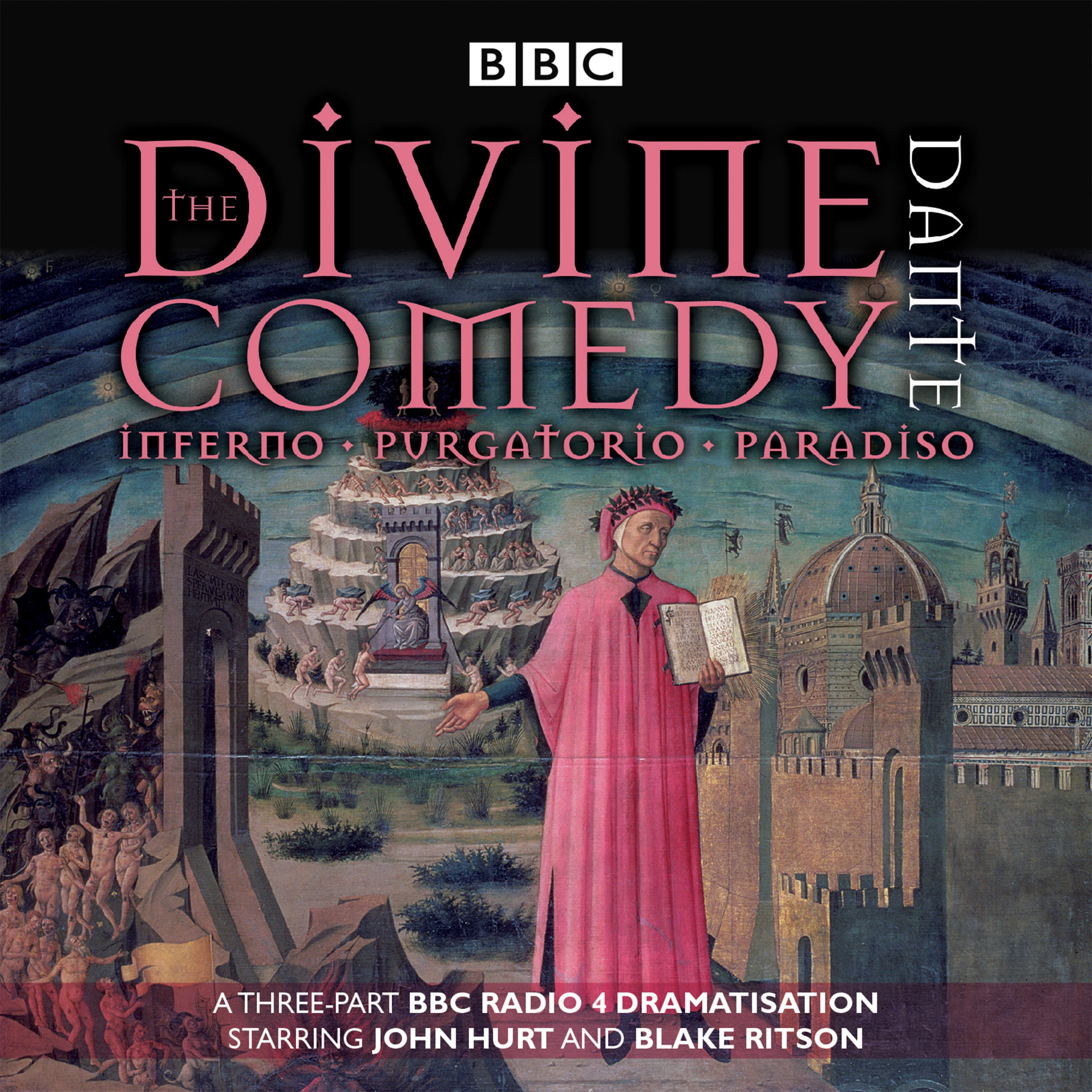
Blake Ritson, David Warner, Hattie Morahan and John Hurt star in this BBC Radio 4 dramatisation of Dante's epic poem.

Blake Ritson, David Warner, Hattie Morahan and John Hurt star in this BBC Radio 4 dramatisation of Dante's epic poem.

Inferno: Thirty-five year old Dante finds himself in the middle of a dark wood, in extreme personal and spiritual crisis. Hope of rescue appears in the form of the venerable poet Virgil, now a shade himself, who offers to lead Dante on an odyssey through the afterlife, beginning in the terrifying depths of Hell.

Purgatorio: Dante is led up Mount Purgatory by his guide. They encounter numerous souls who have embarked on the same difficult journey - one that will eventually lead to their spiritual salvation.

Paradiso: Dante's journey comes to a glorious conclusion as he is led by Beatrice, through the spheres of Paradise and into the presence of God himself. As they ascend, they encounter a number of souls who have also achieved blessedness.

Many years later, the older Dante reflects on the episodes from his life that have inspired his great poem.


©2014 BBC Studios Distribution Ltd (P)2014 BBC Studios Distribution Ltd

  • Published: 18 September 2014
  • ISBN: 9781910281437
  • Imprint: BBC DL
  • Format: Audio Download
  • Length: 2 hr 51 min
  • Narrators: Blake Ritson, John Hurt, David Warner, Hattie Morahan

About the authors

Dante Alighieri

Date: 2013-08-06
Dante, or Durante deli Alighieri, was born in Florence, Italy, circa 1265. His family was connected with the Guelph political alliance, supporters of the Papacy. His mother died before Dante’s tenth birthday. Dante himself was betrothed to Gemma di Manetto Donati when he was aged only 12. The pair went on to marry, but Dante’s true love was for Beatrice Portinari, who would inspire much of his poetry. Dante and Gemma had several children.
Dante was a member of Florence’s Apothecaries’ Guild, though he did not practice as a pharmacist. Allied to the White Guelphs, with whom he fought against the vanquishing Black Guelphs, he was eventually condemned to perpetual exile from Florence. He went first to Verona and then to Liguria. There is speculation that he travelled more widely, including to Paris and Oxford, although this has not been verified.
During his time of exile Dante conceived and wrote the three poems which form The Divine Comedy. He died in 1321, aged 56, of suspected malaria. He was buried in Ravenna, Italy, where a tomb was later erected in his name.

Stephen Wyatt is a playwright and dramatist with extensive experience in stage, radio and television.

Dante Alighieri was born in Florence in 1265 and belonged to a noble but impoverished family.  He followed a normal course of studies, possibly attending university in Bologna, and when he was about twenty he married Gemma Donati, by whom he had several children.  He had first met Bice Portinati, whom he called Beatrice, in 1274, and when she died in 1290, he sought distraction by studying philosophy and theology and by writing La Vita Nuova. 

During this time he became involved in the strife between the Guelfs and the Ghibellines; he became a prominent White Guelf, and when the Black Guelfs came to power in 1302, Dante, during an absence from Florence, was condemned to exile.  He took refuge first in Verona, and after wandering from place to place - as far as Paris and even, some have said, to Oxford - he settled in Ravenna.  While there he completed The Divine Comedy, which he began in about 1308.  Dante died in Ravenna in 1321.

Stephen Wyatt

Stephen Wyatt was born in Beckenham, Kent and brought up in Ealing in West London. He was educated at Latymer Upper School and then went on to Clare College, Cambridge. While at Cambridge, he directed the 1973 Footlights Revue, Every Packet Carries a Government Health Warning, as well as productions of The Mikado, Handel’s Semele and Verdi’s I Due Foscari. His first full-length comedy, Exit, Pursued by a Bear, was produced at the Edinburgh Festival in 1973. After a brief spell as Lecturer in Drama at Glasgow University, he began his career as a playwright in 1975 as writer/researcher with the Belgrade Coventry Theatre in Education team. In 1982 and 1983 he was Resident Writer with the London Bubble Theatre. Stephen has worked widely as a freelance playwright in theatre, radio and television ever since. He also has considerable experience as a teacher, workshop leader and script reader and in the creation of audio guides. The first piece he wrote for television was a play called Claws which led to his being commissioned to write Paradise Towers and then The Greatest Show in the Galaxy for Doctor Who. In 2008, his play, Memorials to the Missing, won the Tinniswood Award for best original radio script of 2007 as well as Silver in the Best Drama category of the 2008 Sony Radio Awards. He spent two years as Royal Literary Fund Writing Fellow at the University of Sussex and in the autumn of 2011 he took up a post as RLF Writing Fellow on Greenwich University’s Maritime campus. Author biography by David J. Howe, author of The Target Book, the complete illustrated guide to the Target Doctor Who novelisations.

Praise for The Divine Comedy

In a glorious adaptation of The Divine Comedy, Stephen Wyatt takes a potshot at bankers, forced to sit forever on hot sands under fiery rain.

Moira Petty, The Stage

He’s done a remarkable job. Out go the cantos and rigid rhyming structures. In comes a flowing narrative that loses none of the evocative imagery of the original. And it does Wyatt’s case no harm that the three central characters — Dante the younger, Dante the elder and Virgil, his ghostly omnipresent guide through hell, purgatory and paradise — are played by Blake Ritson, John Hurt and David Warner.

Jane Anderson, Radio Times