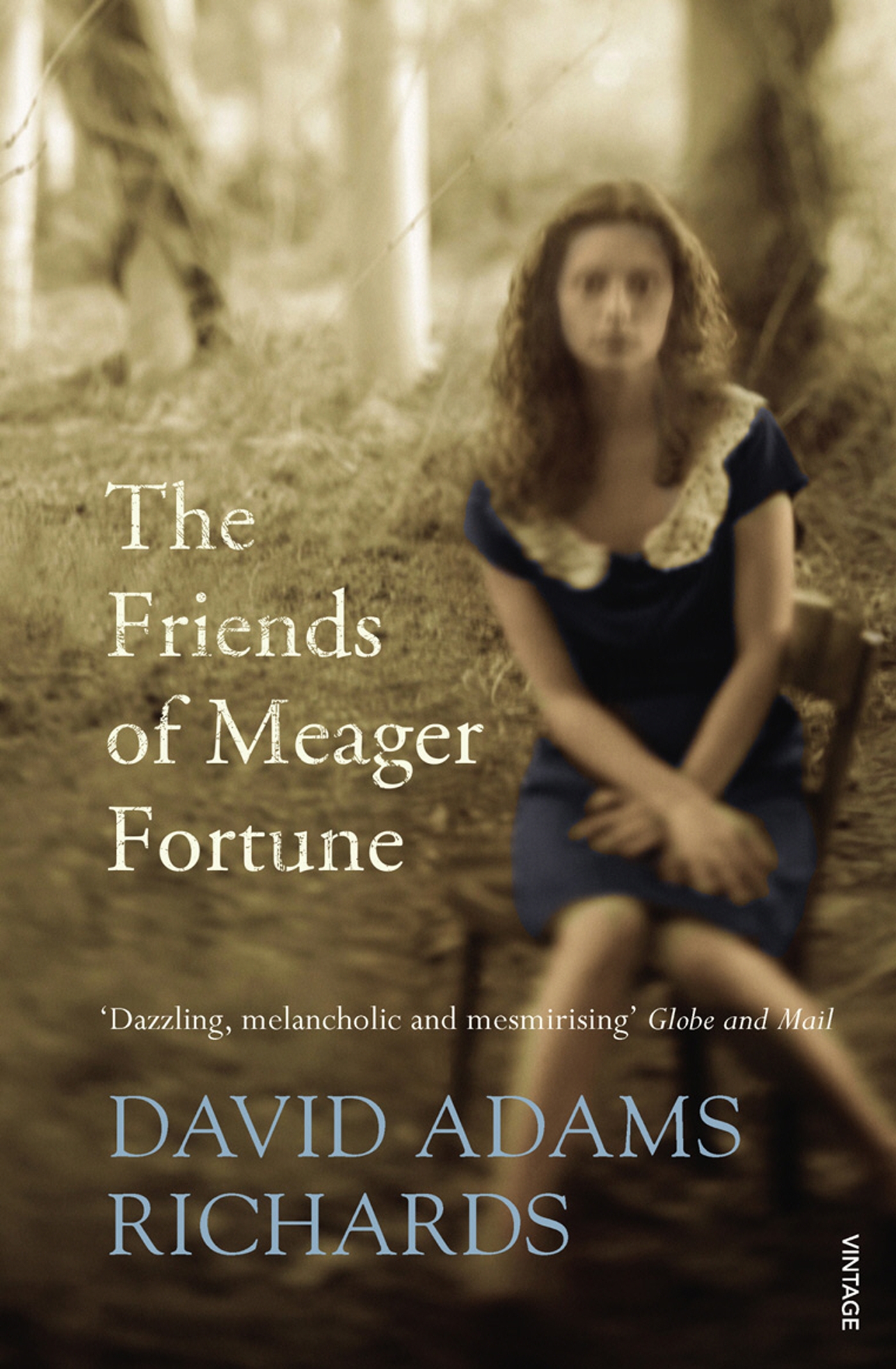
Another remarkable novel by one of Canada's greatest novelists, a story of good and evil, fate and hope, set against the background of a logging town on the brink of change.
Will Jameson has a temperament of iron, standing up to men twice his age when he takes over the Jameson lumber company after his father's death. His younger brother Owen is sensitive, literary and fanciful. But when Will dies suddenly and Owen's beloved Lula rejects him, Owen's deeper character comes to light: joining the army in the hope of getting himself killed, instead Owen returns home a decorated war hero.
Then he falls in love with the beautiful, childlike Camellia - the wife of Will's old friend Reggie Glidden - and soon Owen and Camellia find themselves watched on all sides, caught in the teeth of an entire town's gossip and hypocrisy. Inexorably, they are pulled into a chain of events that will end with death, disappearance and a sensational trial.
The Friends of Meager Fortune is a transfixing love story and a devastating portrait of a society - but it is also a brilliant commemoration of the passing of a world, that of the lumberjacks who felled the trees by hand and dragged them down mountainsides with horses. Owen Jameson begins what will become the greatest cut in New Brunswick history, his men setting up camp on the notoriously dangerous Good Friday Mountain. The teamsters spend months in pitiless ice and snow, daily pitting themselves against nature and risking their lives for scant reward, in the last moments before the coming of mechanization that will make them obsolete. This heroic, brutal life is all Meager Fortune, the camp keeper, knows. A good and innocent man, he shows unexpected resolution in the face of the betrayals of the more worldly men around him.
Rich with all the passion, ambition and almost mythic vision that defines David Adams Richards' work, The Friends of Meager Fortune is a profound and important book about the hands and the heart; about true greatness and true weakness; about the relentlessness of fate and the evil that men and women do. Wise, stark, and without a false word in it, it cements David Adams Richards' claim to be the finest novelist at work in Canada today.
Born in 1950 in Newcastle, New Brunswick, David Adams Richards was the third of William and Margaret Richards' six children. He found his calling at the age of fourteen, after reading Oliver Twist, and embarked on a life of extraordinary purpose, one which he says didn't help his finances: "Sometimes . . . I thought it would be better if I were a plumber, but I wouldn't be very good."
At the age of twenty and after finishing his first novel, The Keeping of Gusties, Richards went in search of a community of writers. His quest ended when he met a group of academics at the University of New Brunswick. Richards would hitch-hike from his home in Newcastle to Fredericton every Tuesday night to meet with them and read from his work. The literary evenings were held on campus at McCourt Hall, in an outbuilding formally used to store ice. The group quickly became known as the Ice House Gang. There he received encouragement from established writers, including the late Alden Nowlan, whom he names as important influences along with Faulkner, Pushkin, Dostoevsky and Emily Brontë. It was during his time with these writers that Richards wrote two-thirds of his second novel, The Coming of Winter, which was published by Oberon Press in 1974.
In 1971, Richards married Peggy McIntyre. They spent the first years of their marriage travelling throughout Canada, Europe and Australia. It was on these long sojourns away from the Mirimachi that Richards found he could write about the home he loved, regardless of where he lived. As he continued to write, Richards took postings as writer-in-residence at universities in New Brunswick, Ontario, Alberta and at Hollins University in Roanoke, Virginia. In 1997, they moved to Toronto with their sons John Thomas and Anton.
The Miramichi region has continued as the heart of Richards' fiction throughout his career. As he explained in an interview with JanuaryMagazine, his connection to the area and to the rural lives of its inhabitants is central to his fiction, yet does not reflect a limited scope: "It's very important, because the characters come from the soil. They're like the trees, in a certain respect. They cling to that river and that soil, but as Jack Hodgins once said about my writing—which was one of the kindest things any writer has said about my writing—he said: 'David, you aren't writing about the Miramichi Valley, you're writing about Campbell River where I come from. Because every character you talk about is a character I've met here in Campbell River.' And that's basically what I'm doing. Of course my people are Miramichi. Of course they come from the fabric and the soil of the Miramichi but if that was the only thing that was interesting about them, I wouldn't bother writing about them."
The relocation to Toronto was not without its difficulties, though. As Richards documented in the memoir Lines on the Water, he loves fly-fishing on the Miramichi River. Yet once he was no longer a resident, he was unable to get a fishing licence for the region. Thankfully, said Richards, the local government proclaimed him an "honorary Miramichier"—"So I can go fishing. It was very nice of them and very touching." He has also written a non-fiction book on the place of hockey in the Canadian soul, called Hockey Dreams.
Richards has received numerous awards and prizes throughout his career. Most notably, he is one of few writers in the history of the Governor General's Literary Awards to win in both the fiction (Nights Below Station Street) and non-fiction (Lines on the Water) categories. In addition to these two wins, he was nominated for Road to the Stilt House (in 1985), For Those Who Hunt the Wounded Down (in 1993) and Mercy Among the Children (in 2000). Considered by many to be Richards' most accomplished novel, Mercy was co-winner of the Giller Award in 2000, and was shortlisted for the Trillium Award and the Thomas Raddell Award. It also won the Canadian Booksellers Association author of the year and fiction book of the year awards. Over the years, Richards has also won countless regional awards for his novels and was awarded the prestigious Canada-Australia Literary Prize in 1992. More recently, The Lost Highway was shortlisted for the Governor General’s Literary Award and longlisted for the Scotiabank Giller Prize and The Friends of Meagre Fortune won the Commonwealth Writers’ Prize for Best Book and was longlisted for the Scotiabank Giller Prize.
Despite all of these successes, it was years before Richards made money at writing. He laughs at the sales of his early work: "For a long while if I sold 200 books, I'd be saying: Oh, great! And, you know, a $50 advance! That's great. I only worked three years, I don't know if I can spend $50."
Also a screenwriter, Richards has adapted a number of his novels for the small screen. In 1990, he adapted his novel Nights Below Station Street, and in 1994 he penned the teleplay "Small Gifts," for which he won his first Gemini. He won his second for his screen adaptation of For Those Who Hunt the Wounded Down, and later co-wrote the screenplay for The Bay of Love and Sorrows, released as a feature film in 2002.
In addition to his novels and non-fiction books, Richards' short stories and articles have been published in literary magazines and anthologies. His literary papers were acquired in 1994 by the University of New Brunswick.