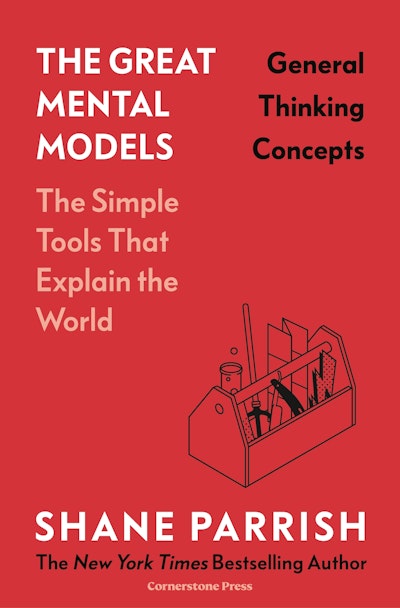
Time and time again, great thinkers such as Charlie Munger and Warren Buffett have credited their success to mental models–representations of how something works that can scale onto other fields.
Mastering a small number of mental models enables you to rapidly grasp new information, identify patterns others miss, and avoid the common mistakes that hold people back.
Volume 3 of The Great Mental Models series focuses on systems and mathematics, simplifying more than twenty-four key concepts from these technical fields into easy-to-understand terms. It provides insights into the unseen mechanisms that influence our environment and teaches you how to apply these principles to benefit your life.
Some of the mental models covered in this book include:
- Margin of Safety: Engineers design for extremes, not averages. To create a robust system, ensure a meaningful gap between what the system is capable of handling and what it is required to handle.
- Compounding: The most powerful force in the universe can work in domains other than money.
- The law of diminishing returns: Inputs to a system lead to more output, up until a point where each further unit of input will lead to a decreasing amount of output.
- Regression to the mean: Above- or below- average performance tends to correct towards the average over the long term.
The Great Mental Models series demystifies once elusive concepts and illuminates rich knowledge that traditional education overlooks. This series is the most comprehensive and accessible guide on using mental models to better understand our world, solve problems, and gain an advantage.
From the New York Times bestselling author of Clear Thinking and Farnam Street founder, Shane Parrish.
The third book in the timeless Great Mental Models series.
Time and time again, great thinkers such as Charlie Munger and Warren Buffett have credited their success to mental models–representations of how something works that can scale onto other fields.
Mastering a small number of mental models enables you to rapidly grasp new information, identify patterns others miss, and avoid the common mistakes that hold people back.
Volume 3 of The Great Mental Models series focuses on systems and mathematics, simplifying more than twenty-four key concepts from these technical fields into easy-to-understand terms. It provides insights into the unseen mechanisms that influence our environment and teaches you how to apply these principles to benefit your life.
Some of the mental models covered in this book include:
- Margin of Safety: Engineers design for extremes, not averages. To create a robust system, ensure a meaningful gap between what the system is capable of handling and what it is required to handle.
- Compounding: The most powerful force in the universe can work in domains other than money.
- The law of diminishing returns: Inputs to a system lead to more output, up until a point where each further unit of input will lead to a decreasing amount of output.
- Regression to the mean: Above- or below- average performance tends to correct towards the average over the long term.
The Great Mental Models series demystifies once elusive concepts and illuminates rich knowledge that traditional education overlooks. This series is the most comprehensive and accessible guide on using mental models to better understand our world, solve problems, and gain an advantage.