> Skip to content
[]
  • Published: 30 April 2011
  • ISBN: 9781407073996
  • Imprint: Vintage Digital
  • Format: EBook
  • Pages: 496

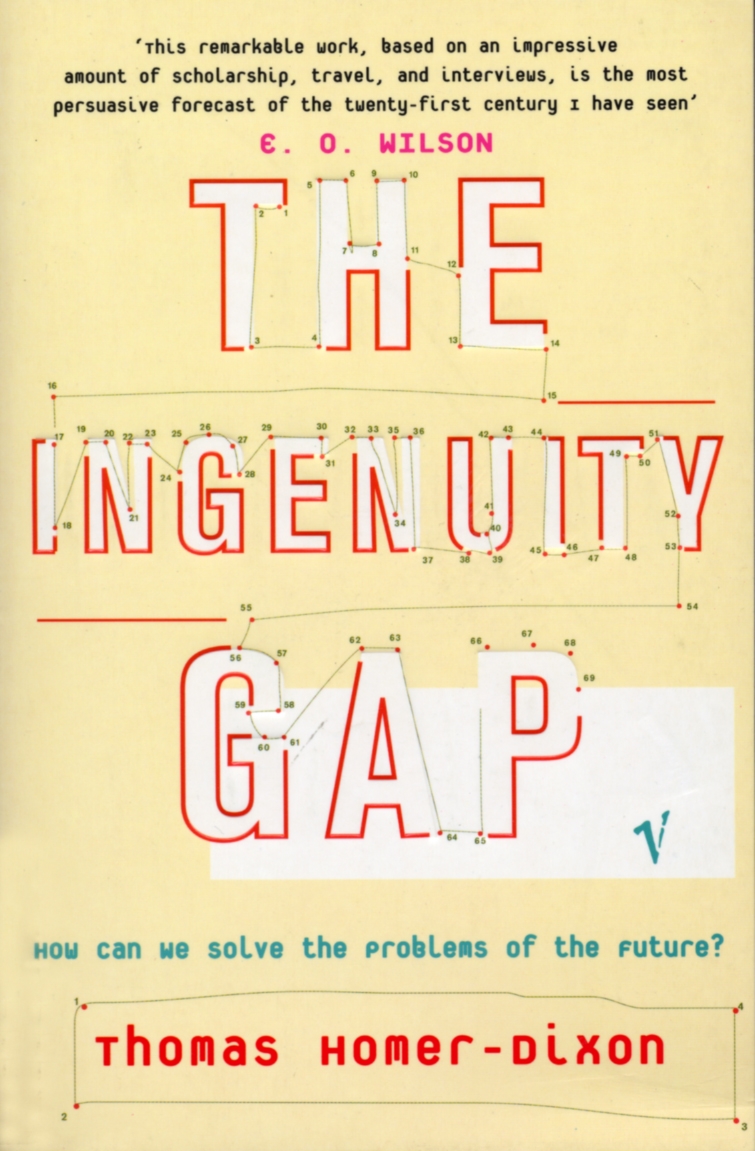
The Ingenuity Gap


'This remarkable work, is the most persuasive forecast of the twenty-first century I have seen. E. O. Wilson

Is our world becoming too complex and too fast-paced to manage? The challenges facing human societies - from international financial crises and global climate change to pandemics of tuberculosis and AIDS - converge, intertwine, and often remain largely beyond our ken. Most of us suspect that the 'experts' don't really know what's going on and that as a species we have released forces that are neither managed nor manageable. This is the 'ingenuity gap' - the term coined by Thomas Homer-Dixon - the critical gap between our need for practical and innovative ideas to solve complex problems and our actual supply of those ideas. Homer-Dixon shows us how, in our complex world, while poor countries are particularly vulnerable to ingenuity gaps, our own rich countries are no longer immune. When the gap widens political disintegration and violent upheaval can result, reaching into our own economies and daily lives in subtle, unforeseen ways.

  • Published: 30 April 2011
  • ISBN: 9781407073996
  • Imprint: Vintage Digital
  • Format: EBook
  • Pages: 496

About the author

Thomas Homer-Dixon

Dr. Homer-Dixon’s two books for a mainstream audience were both #1 bestsellers, and multi-award winning: The Ingenuity Gap: Can We Solve the Problems of the Future? and The Upside of Down: Catastrophe, Creativity, and the Renewal of Civilization. His Environment, Scarcity, and Violence won the 2000 Caldwell Prize of the American Political Science Association.

He is Director and Founder of the Cascade Institute at Royal Road University, and holds a University Research Chair in the Faculty of Environment at the University of Waterloo, Canada. He received his Ph.D. from the Massachusetts Institute of Technology in international relations, defense and arms control policy, and conflict theory, and between 2009 and 2014 was founding director of the Waterloo Institute for Complexity and Innovation.

His work today focuses on threats to global security in the 21st century, including economic instability, climate change, and energy scarcity; and on how people, organizations, and societies can better resolve conflicts and innovate in response to complex problems. His work draws on political science, economics, environmental studies, geography, cognitive science, social psychology, and complex systems theory.
He has written for non-academic audiences in Foreign Policy, Scientific American, The New York Times, and the Financial Times. His academic writing has appeared in leading journals, including Ambio, International Security, Journal of Peace Research, and Population and Development Review. He is a widely sought speaker around the world. He has also consulted to senior levels of government in the United States, Canada, and the United Kingdom.

Also by Thomas Homer-Dixon

See all

Praise for The Ingenuity Gap

Tad Homer-Dixon is a rare kind of public intellectual, who combines real expertise with a commitment to communicate to the wisest possible readership. In The Ingenuity Gap he wants us all to wake up to the fearful possibility that our blithe trust in science and technology may be misplaced. Human ingenuity may not be capable of copying with tow emerging crises of this century and the next: population growth and environmental despoliation. Read Homer-Dixon's wake-up call and you will see the future very differently

Michael Ignatieff

Superlative on detail, excellent long passages about soil, finance, engineering, climatology

Guardian