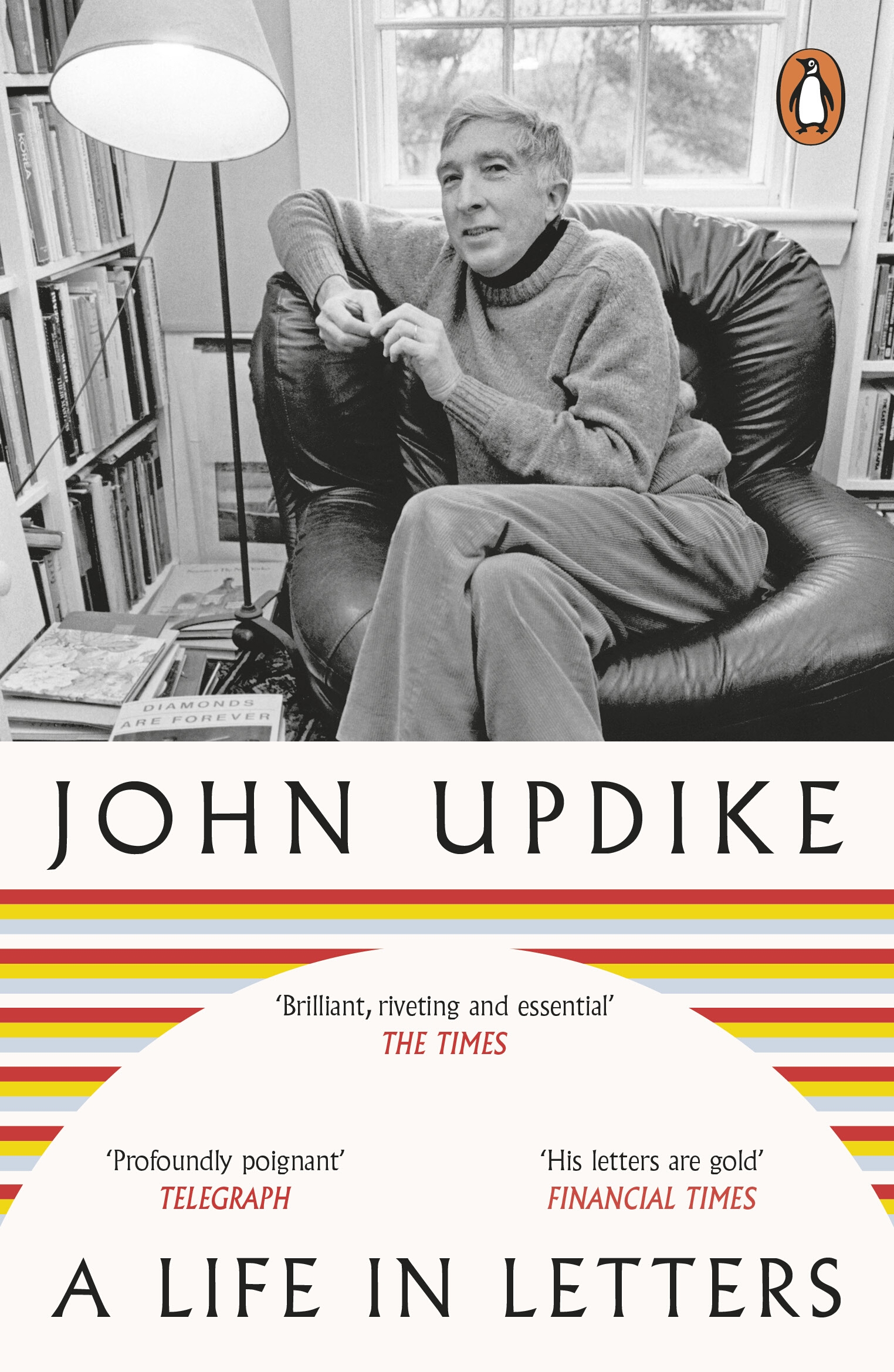
- Published: 6 November 2025
- ISBN: 9781405968492
- Imprint: Penguin eBooks
- Format: EBook
- Pages: 912
A Life in Letters





- Published: 6 November 2025
- ISBN: 9781405968492
- Imprint: Penguin eBooks
- Format: EBook
- Pages: 912

Missives from the mountain . . . A sprightly and revealing collection by the writer who captured postwar American life, love, and loss
Kirkus
One of the greatest American writers of the 20th century . . . Brilliant, riveting and essential for anyone remotely interested in Updike; shockingly salacious enough to enthral the remotely curious; and cleverly annotated for easy reading . . . The best letters are those to his wives in the 1970s, where you realise that Updike’s greatness as a writer lies not in his much-lauded descriptive powers, nor in his ability to weave arcane areas of computer science or theology into his fiction, but in his ruthlessly honest psychological acuity, as he lays himself bare — right down to admitting he likes to beat his wife’s lover at golf
The Times
By turns fascinating, embarrassing, and even moving, the letters reveal that Updike’s ceaseless coupling was never quite about lust at all. It was about faith — about locating meaning amid the mundanities of the modern world
UnHerd
Magnificent, evocative . . . A profoundly poignant portrait, an invaluable historical document, and a timely reflection on the eternal tensions between societal conventions and free speech . . . Done this well, epistolary biography comes to seem the best and most honorable kind
The Telegraph
John Updike had the mind of a middling middle-class postwar American male, and the prose style of a literary genius . . . Friends, enemies and lovers animate more than 60 years of the author’s remarkable correspondence . . . John Updike, the man incapable of writing a bad sentence
Guardian
Wonderfully copious . . . Updike simply had it: an instinctive feeling for the shape of American sentences, for the murmuring music of nouns and verbs and the way they could pin reality to the page
New Statesman
The book’s editor James Schiff’s footnotes provide illuminating context and help to bring Updike and his world charging into the present with such force that, at times, it is difficult to accept that the man who wrote these letters is dead . . . Updike was a prodigious correspondent but this selection is also a paean to the vanishing art of letter writing. Will such a book be possible in the future? A dashed off email is not going to reveal a personality as vividly, no matter who writes it. Updike would not have accepted a sombre ending so I’ll just say his letters are gold, shining with insights about literature and life, and an opportunity to hear his voice as clearly as anywhere else in his oeuvre
Financial Times
The letters and postcards (Updike loved a postcard) contain more than just pretty phrases. He talked shop – the writing, reading and manufacture of books – but also engaged in brave and sometimes anguished explorations of ambition, lust, love, guilt and shame
The Spectator
A dizzyingly great collection, from undergraduate to world-striding voice, of the loves and deep interests of an American titan. Such writing!
Big Issue, 'Great Reads of 2025'
Updike reveals himself here to be just as sharp, charming, and humane in correspondence as he was in fiction. These letters confirm what admirers have long suspected: that his gift for language was not confined to the printed page but thrived in the everyday act of writing to others . . . For readers of his fiction, it enriches and reframes familiar themes; for newcomers, it provides an introduction to one of America’s most distinctive writers
Voice Mag
It’s all here, Updike in full, and almost none of it has gone stale. An unbroken arc from boyhood to infirmity, the gravity’s rainbow of a life, career and mind
London Review of Books
An epistolary account of much of Updike’s life, which follows him through childhood, college, his literary career, his relationship with this magazine, his two marriages, fatherhood, multiple affairs, and more. The result is an inadvertent self-portrait, written with wit and grace. Updike maintains a certain ebullient positivity, even in his darker moments
The New Yorker
In the aggregate, Updike’s letters could constitute the outline for a never-published Updike novel . . . Updike is, as ever, captivating on the page
The Atlantic
[Updike’s letters] have the repleteness of his fiction, the springy, unexpected notice of the smallest particulars. This huge volume is readable in a way that too many collections of writers’ letters, however useful to scholarly research, simply are not. Lovely flourishes remind us of Updike’s talent for light verse . . . [his] tenderness, a natural instinct for conciliation, always re-emerges . . . These letters make plain [his] ability to marvel and thank [and the] willingness to take America to his bosom . . . that guarantees his permanent place in this country’s literature
Wall Street Journal
What an enormous and beneficent bounty these letters are for anyone who cares about [American] literature during the last half century . . . Come for the gossip . . . Come for the love letters . . . Come to watch him cope with the aftermath of fame . . . Updike’s letters sing because he cared so intensely about getting the words right
New York Times