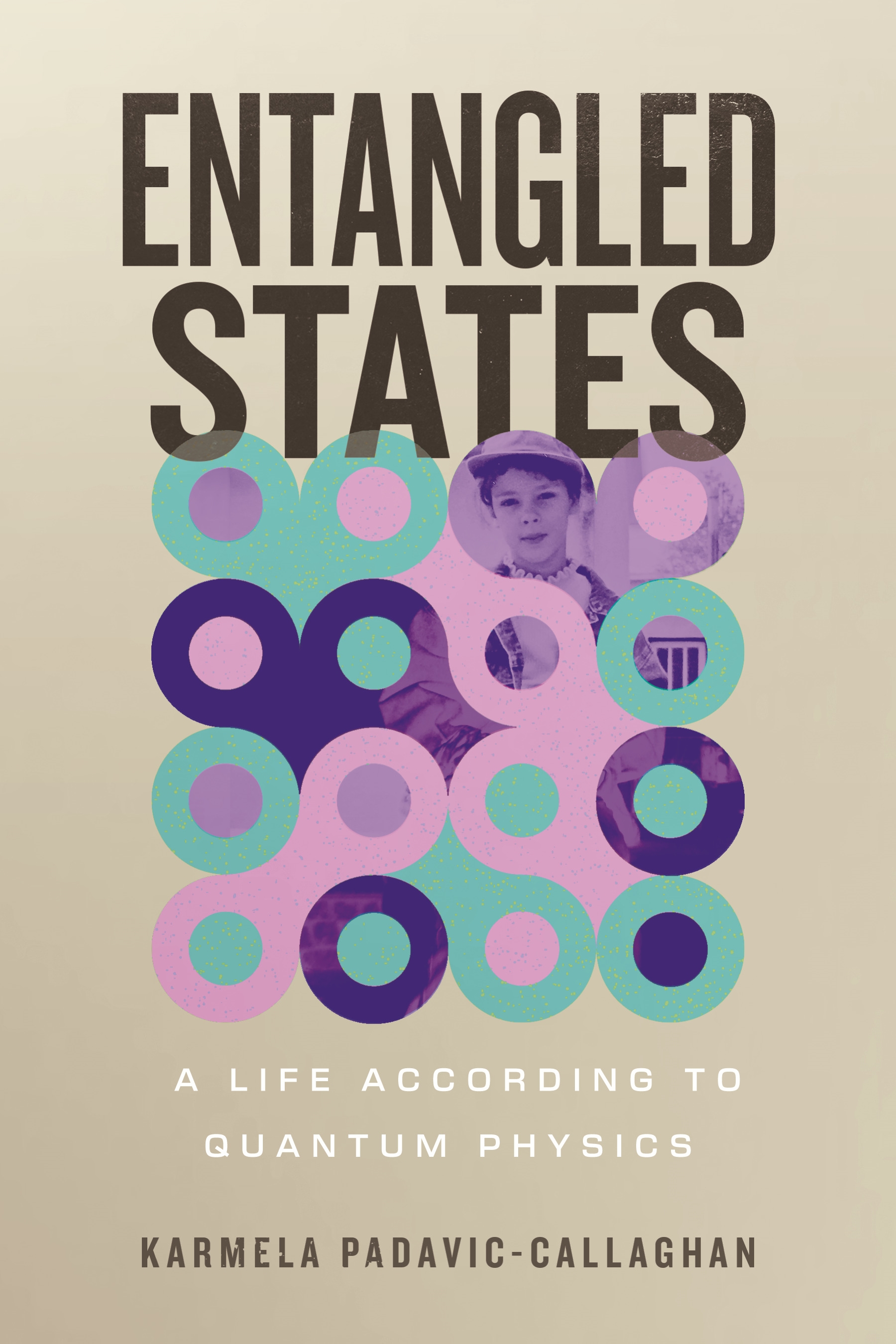
- Published: 23 June 2026
- ISBN: 9780807016985
- Imprint: Beacon Press
- Format: Hardback
- Pages: 248
- RRP: $70.00
Entangled States
A Life According to Quantum Physics


- Published: 23 June 2026
- ISBN: 9780807016985
- Imprint: Beacon Press
- Format: Hardback
- Pages: 248
- RRP: $70.00
Entangled States is a stunning and invigorating memoir at the intersections of science, gender, place, and wonder. I was awed by Karmela Padavic-Callaghan's ability to engage elevated physics theory alongside such gorgeous and thoughtful prose, and to meditate so intimately on the particularities of a human life alongside explanations for our universal atomic experiences. A truly remarkable debut.', Raechel Anne Jolie, author of Rust Belt Femme
'With Entangled States, Karmela Padavic-Callaghan offers readers an utterly unique journey into the quantum life—one where a love of quantum physics helps a queer immigrant make sense of who they are and make meaning of the cosmos. Come for the analysis of Freddie Mercury’s farewell album, stay for the clear, accessible explanations of next-generation quantum information science. Padavic-Callaghan has written an inspiring book about physics that beautifully centers the importance of being true to yourself.', Chanda Prescod-Weinstein, author of The Disordered Cosmos: A Journey into Dark Matter, Spacetime, and Dreams Deferred
'Padavic-Callaghan is the ideal shepherd for today’s science reader eager to feel through the fields, peaks, and valleys of quantum physics. A lyrical study of temporal frames and the capacious interactions coupled with a powerful self-inquiry into the personal and cultural cost of achieving academic success as a late-twentieth-century queer immigrant. Entangled States is a portrait of survival through the systems of irreducibility, illustrating the probabilities of different, dare I say, exciting outcomes in a powerfully lived life.', Raquel Gutiérrez, author of Brown Neon
'ENTANGLED STATES [STARRED REVIEW!]
A Life According to Quantum Physics
Author: Karmela Padavic-Callaghan
Review Issue Date: March 1, 2026
Online Publish Date: February 2, 2026
Publisher:Beacon Press
Pages: 256
Price ( Hardcover ): $28.95
Publication Date: May 19, 2026
ISBN ( Hardcover ): 9780807016985
Section: NonFiction
Coming of age in superposition.
“The quantum world was the first place where I knew queerness,” Padavic-Callaghan writes. “Meeting its not-wave-not-particle denizens was the first time I ever saw something like a possibility of myself.” Born in 1991 in what had been Yugoslavia, in the midst of war, Padavic-Callaghan moved to the U.S. at 16 and eventually became a physicist, then a science journalist. Feminine and masculine, Croatian and American, scientist and reporter—for every binary, they were somehow neither and both. So it makes sense that their book—a work of memoir and science writing—should be the same. As Padavic-Callaghan moves between science and story, the physics becomes a metaphor for the personal, and vice versa. One minute we’re learning about the fragility of quantum memory, the next we’re watching Padavic-Callaghan as a kid headbanging to hard rock in the car with their father. The “many worlds” interpretation of quantum theory inspires us to take all the possible versions of ourselves that might exist in parallel universe and live them fully and fiercely in this one. “Unlike Schödinger’s cat,” they write, “which stays in a single state once you have collapsed its wavefunction, I could never stay collapsed for very long.” Because the book is organized thematically, we end up revisiting the same time periods, and in places, the story gets redundant. Some personal sections—the chapter on makeup and fashion, for one—drag on past the point of the emotional punch. Still, there’s fresh talent here. Padavic-Callaghan’s prose is vulnerable and sharp. They describe crying as grief “transmuted into water and salt,” and a toothache as a “scream…trapped in the bone.” In their hands, the mathematics of knot theory becomes moving. They push the boundaries of what a science book can be. They leave us with the sense that if quantum physicists can build “tolerance for complexity and in-between-ness,” maybe the rest of us can, too.
An unconventional take on physics that stings like an exposed nerve and shines with humanity.', Kirkus Reviews *starred review*
'Entangled States: A Life According to Quantum Physics is not your typical pop-sci book. Authored by Karmela Padavic-Callaghan, a science journalist and writer who has worked with major magazines like New Scientist, it beautifully blends quantum physics with memoir. Padavic-Callaghan is a Croatian non-binary scientist who moved to the United States for their education when they were sixteen. They hold a PhD in quantum physics, and this is their debut.
Entangled States is neither fully a memoir nor a science book. Each chapter blends key concepts of physics, especially quantum mechanics, with important parts of the author's life. Padavic-Callaghan successfully draws parallels and often indirectly teaches us the lessons various experiences have taught them.
The first chapter, for example, deals with quantum computers and the quantum phenomena that make them work. It describes how they store and process information and why they can be prone to errors and data corruption. From there, Padavic-Callaghan goes on to narrate memories from their childhood, as well as those of their family during the Yugoslav wars. They conclude that our memories are also prone to corruption, since they can become fuzzy or unreliable due to intense feelings and our unconscious efforts to minimize trauma. Another scientific concept, found in multiple chapters, is the indeterminate nature of quantum physics, where exclusive categories do not really exist. The wave-particle duality (see Beyond the Book), for example, states that electrons or photons can behave both like particles and waves. Similarly, Padavic-Callaghan's life is defined by duality and multiplicity. They refuse to place themselves into a single category, be it nationality, gender, profession, or other aspects of identity, and instead embrace every side of who they are.
The book is well balanced between memoir and science, especially in the beginning. As it progresses, it starts leaning more heavily toward the author's experiences. It also indirectly touches on many societal topics, such as immigration, gender, mental health, funding in sciences, the "male-ness" of physics research, and more.
The book is split into three parts. The first deals with concepts of time, the second with space, and the last with interaction. A fresh aspect is the constant changes in style and tone. One chapter is written in the second-person singular as Padavic-Callaghan describes their struggles as a PhD student living away from their country and the difficult early Covid years. This shift raises the emotional impact on the reader. Other chapters, like one on electromagnetism, include "class assignments" to introduce physics concepts, transferring Padavic-Callaghan's passion for teaching to the reading experience. These frequent shifts in style are neither confusing nor wearisome. They work in tandem with the overall theme of fluidity and not having to be just one thing. The only structural drawback is that the book's thematic divisions mean we revisit some events multiple times, making it feel a bit repetitive.
Padavic-Callaghan has a pleasant, engaging, and easy-to-follow voice. The memoir sections are rich in emotion and approach a kind of lyricism, while the science parts remain digestible and free of jargon. Sometimes, however, they become a bit oversimplified. Key aspects of theories are left out, which may make some concepts harder to understand for readers unfamiliar with the topics discussed.
One of the greatest strengths is the writer's honesty and vulnerability as they describe the lessons their experiences have taught them through the years. This focus makes the book quasi-self-help, but without forced optimism or condescension. For me, the way Padavic-Callaghan blends science and memoir in Entangled States is ultimately what makes the book so compelling.
Reviewed by Sofia Chatzistefanou', Sofia Chatzistefanou, BookBrowse
'In Entangled States, science journalist Padavic-Callaghan pulls off two magic tricks at once. In passages of lucid physics translation, they somehow make nature’s most mystifying shenanigans go down easy. And then, in interposed sections of memoir, they wield those nuggets of understanding as potent metaphors for life’s great challenges. The two threads coil seamlessly through deeply personal essays on immigrating from Croatia, metal music, queerness and paths not taken. This book embodies my favorite unsung virtue of science: that every lesson about the universe is a new lens into the strange experience of being one of its living subjects. You leave feeling that the quantum world is actually more relatable than it is weird, and that pop science can be as soul-nourishing as a good novel. —Joseph Howlett, staff reporter', Joseph Howlett, Scientific American newsletter