- Published: 3 November 2026
- ISBN: 9781962770613
- Imprint: NY Review Books
- Format: Paperback
- Pages: 456
- RRP: $65.00
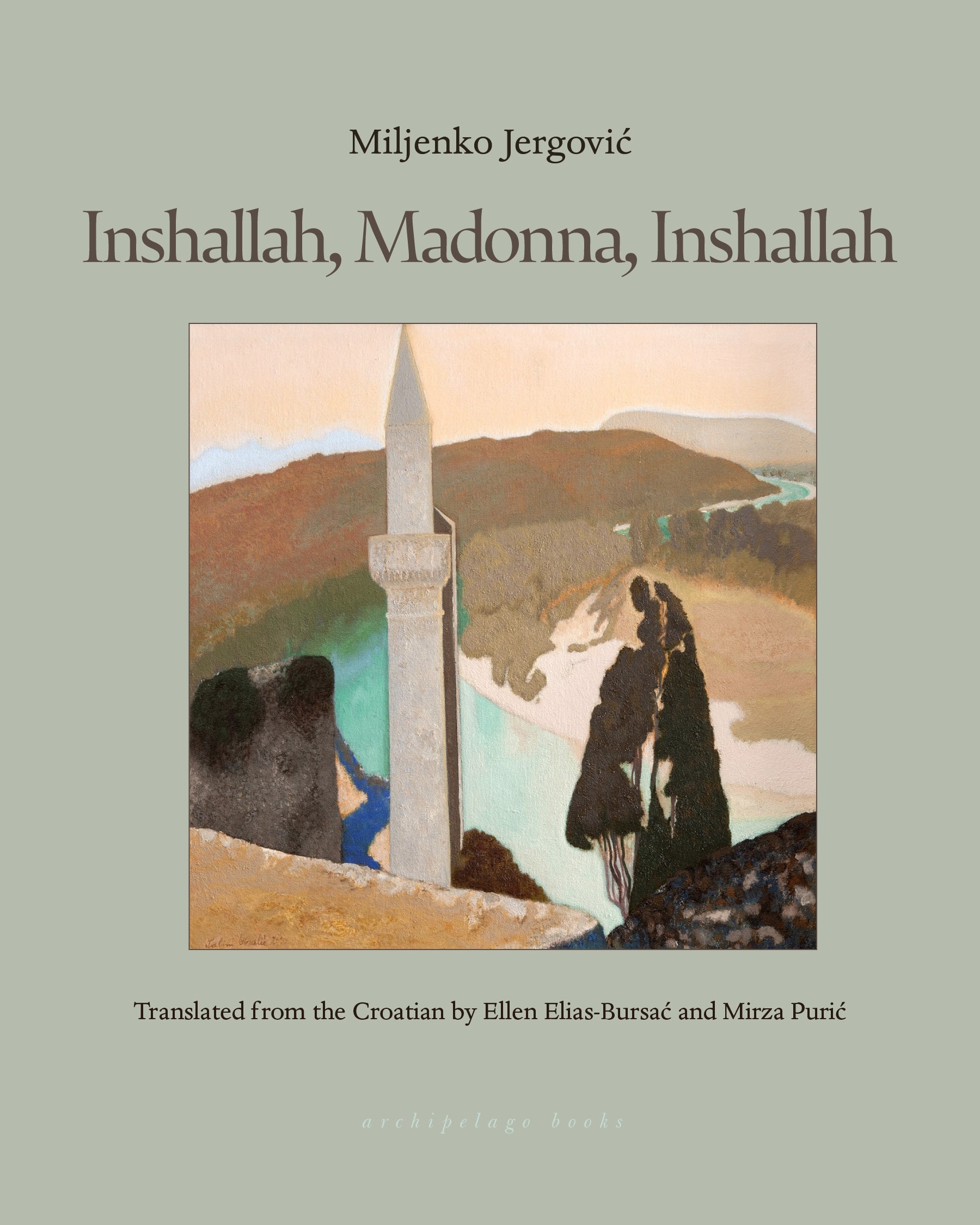
Inshallah, Madonna, Inshallah


- Published: 3 November 2026
- ISBN: 9781962770613
- Imprint: NY Review Books
- Format: Paperback
- Pages: 456
- RRP: $65.00
About the authors

"These stories examine jealousy, longing, loss, lust, murder, and unrequited love . . . Jergović creates characters who represent the multifarious facets found in Balkan society (Christians, Jews, and Muslims) while using a witty, sometimes philosophical style." —Erica Swenson Danowitz, Library Journal
"Every story is characterised by the universal intimacy of the voice of a stranger telling you strange tales around a fire. Sometimes there is magic explicitly at play . . . Sometimes, with the freedom of unreliable narrators and prophetic dreams, reality in Jergović’s stories bends only slightly . . . The book stands as a record of Jergović’s people, a collection of mythical voices that can speak to God, to Allah, to birds, and dead brothers." —Abigail Riley, Cherwell
"Jergović’s prose lives to serve its setting—when he turns his eye to Sarajevo . . . He captures the valley’s intimate acoustics with striking precision; he is a keen observer of light and sound, and teases out how each story’s protagonist is made up, in part, by their surroundings . . . language itself becomes part of the collection’s folkloric quality: stories with obscure beginnings, with details written and rewritten across decades and languages, drifting gently from beauty to horror and back again . . . Jergović succeeds in bringing the reader closer to thoughts and experiences they are loath to set eyes on, but which live alongside us—in our histories, our songs, and our nightmares." —Hannah Jochmans, Words Without Borders
"Whether others see what we see in beauty is at the heart of the short story 'Akrap.' When an angel falls to earth, the woman who finds him can’t prove he’s real. Her blind husband can’t see him. When the angel disappears, some family members believe the woman’s claim, others think it is a sign of her insanity. Miljenko Jergović (in Ellen Elias-Bursać & Mirza Purić’s translation from Croatian) shows us that even the highest form of beauty does not bring consensus." —Madeleine Schwartz, The Dial
"[Jergovic is] a poet, novelist, and journalist of the highest caliber . . . His concern is for the living and in this collection of stories about Sarajevo and its inhabitants he writes about them with the seriousness, sensitivity, quirky intelligence, and gentle humor of a master of the short story." — The New Republic
"Miljenko Jergović is a superb stylist . . . He manages to convey vivid and emotionally rich pictures of everyday life with even the slightest of rhetorical flourishes. His prose can be deceptively simple at times, but this reveals his fine-tuned ear for language that eschews unnecessary complications." — Bojan Tunguz