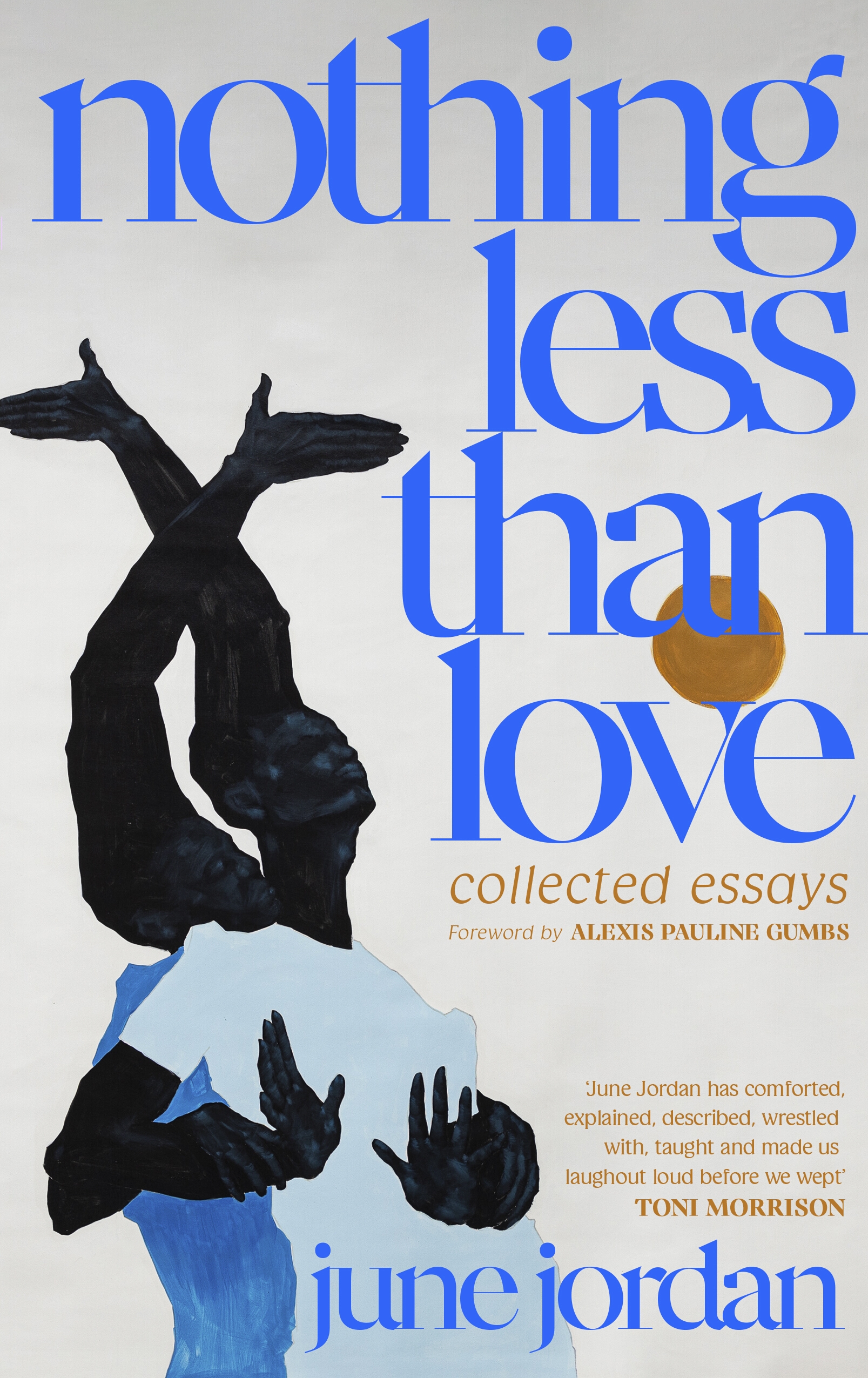
- Published: 15 April 2027
- ISBN: 9781529993011
- Imprint: Merky Books Digital
- Format: EBook
- Pages: 320
Nothing Less Than Love
Selected Essays


- Published: 15 April 2027
- ISBN: 9781529993011
- Imprint: Merky Books Digital
- Format: EBook
- Pages: 320
‘Jordan makes us think of Akhmatova, of Neruda. She is among the bravest of us, the most outraged. She feels for us all. She is the universal'
Alice Walker
‘Her lifelong devotion to justice, equality, and radical democracy seemed to revolve around the pleasure she felt in hurling beautiful words at a world full of racism, poverty, homophobia and inane politicians…There was always joy in her rage’
Angela Davis
‘Whatever her theme or mode, June Jordan continually delineates the conditions of survival - of the body, and mind, and the heart’
Adrienne Rich
‘How many June Jordans we miss today, in their ‘difficult miracle,’ and how many years it may take for the courage to meet them where they stand. The incalculable loss of this music…the wild and free and self-determined breadth of her breath…this poet of Bosnia and Palestine, Bed-Stuy and Nicaragua, Mississippi and Berkeley, a poet of humour and scald, all of it… the long echo of the lines over the course of her life, and all lives informed by hers’
Solmaz Sharif
‘Jordan puts love and delight in her poems, not just vengeance and justice… Writing is an act of faith in a future where meaning is possible’
Elisa Gabbert, The New York Times
‘Jordan held firm to a vision of Black radicalism that was international in its scope, even as a sense of interconnected struggle in continental America lost its grounding… A new generation feels the same pull’
Doreen St. Felix
‘June Jordan’s poems and essays are survival methods, love notes, smoke signals and courageous testimony’
Aja Monet
‘I can think of no other writer more committed to making space for our voices in the world, and I can say without doubt my life in poetry – all it has been, all I dream it to be – would be impossible without June Jordan making that space. And I know I am one of many. We’re like a big choir, singing because June Jordan showed us how’
Ross Gay
‘I believe our love for June Jordan as a poet of the people is encouraged by the ways her work reaches to protect us and by the fact that ‘us’ knows no limits in sex, sexuality, gender, race, or location . . . The legacy of June Jordan is a gift to us in that it allows another opportunity to think not only about what poems are, but also about what poems can do’
Jericho Brown