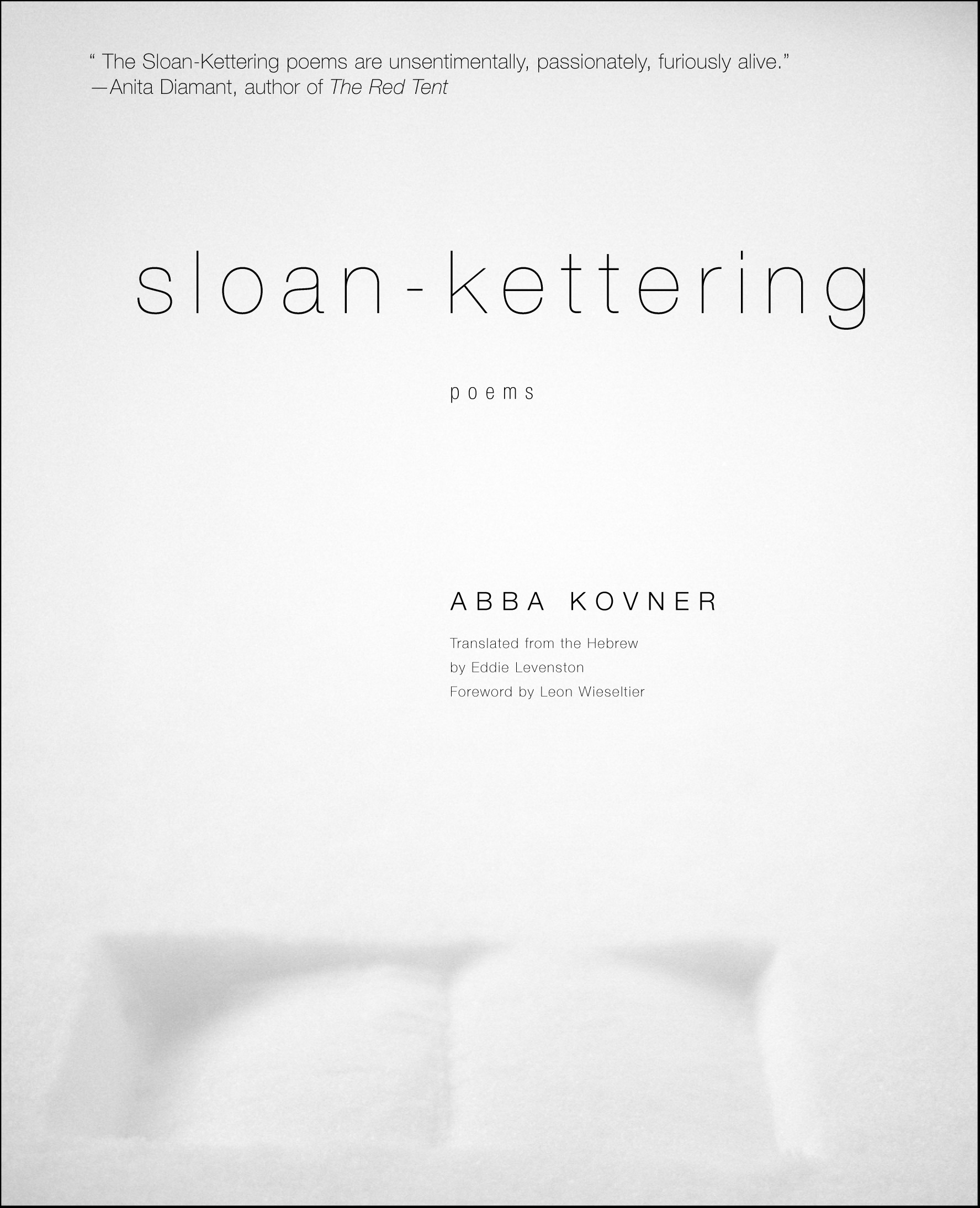
In this luminous collection of poems, Abba Kovner records his deep engagement with life during his last days, as he lay dying of cancer in Memorial Sloan-Kettering Cancer Center. Kovner, the famed Jewish resistance fighter who led the Vilna ghetto uprising during World War II, was also a beloved master of Hebrew literature, and his work has seldom appeared in English. This translation brings us the fierce and humble gratitude of a visionary who has been a fighter not just for himself but for a whole people, as Kovner takes up his pen to say goodbye to a precious, if flawed, world.
Weaving together his perceptions of the present moment (“How little we need/to be happy: a half kilo increase in weight,/two circuits of the corridors”); his sorrow at leaving the world (his wife knitting at his bedside, the chatter of his grandsons); the dramatic loss of his vocal cords (“Have I no right to die/while still alive?”); and memories of his heroic comrades in the Baltic forest, Kovner emerges from these pages with yet another kind of heroism. His continual movement toward freedom and his desire to give a complete account of the gift of life, even as that life is failing, make his words stirring and unforgettable.
Abba Kovner was born in 1918 in Sebastopol. Coi
mitted to Zionism from boyhood, Kovner became
an advocate of armed-resistance during the Second
World War, famously urging his comrades in the
Vilna ghetto not to go "like sheep to the slaughter,
but to stand and fight. Kovner thus became a key
leader in the United Partisan Organization, which
earned out sabotage operations against the Germar
army, first from the ghetto and later from the Balti<
forest. After liberation, Kovner helped to take Jews
from eastern and central Europe into Palestine and
became a key voice in the resettlement of European
Kovner and his wife Vitka, also a resistance leader,
eventually settled on Kibbutz Ein ha-Horesh. After
taking part in the Israeli War of Independence in
1948, Kovner became a writer of both poetry and
prose, winning the Israeli Prize for Literature in
1970. A founder of the Moreshet Holocaust Institute and the Diaspora Museum in Tel Aviv, he died
in 1987.
Related titles
Our top books, exclusive content and competitions. Straight to your inbox.
Thank you! Please check your inbox and confirm your email address to finish signing up.