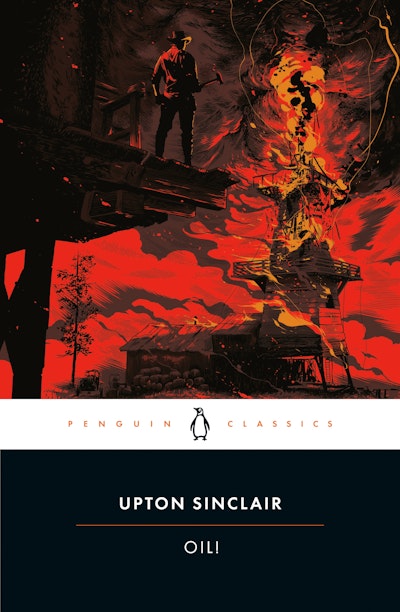
An attractive new edition for this perenial classic.
In this powerful book we enter the world of Jurgis Rudkus, a young Lithuanian immigrant who arrives in America fired with dreams of wealth, freedom, and opportunity. And we discover, with him, the astonishing truth about "packingtown," the busy, flourishing, filthy Chicago stockyards, where new world visions perish in a jungle of human suffering. Upton Sinclair, master of the "muckraking" novel, here explores the workingman's lot at the turn of the century: the backbreaking labor, the injustices of "wage-slavery," the bewildering chaos of urban life. The Jungle, a story so shocking that it launched a government investigation, recreates this startling chapter if our history in unflinching detail. Always a vigorous champion on political reform, Sinclair is also a gripping storyteller, and his 1906 novel stands as one of the most important -- and moving -- works in the literature of social change.
UPTON SINCLAIR was the leading socialist American writer of the 20th century, publishing nearly a hundred books before his death in 1968. His work includes dozens of historical novels, numerous non-fiction works of muckraking journalism, socialist political tracts, drama, poetry, and several volumes of autobiography. Sinclair was also a socialist political organizer and was nearly elected governor of California in 1934. His most famous novel, The Jungle, published in 1906, exposed the horrific conditions in the US meatpacking industry, and is still a best selling book today. Jack London called it "the Uncle Tom's Cabin of wage slavery." Sinclair won the 1943 Pulitzer Prize for fiction for Dragon's Teeth, a novel set during the Nazi takeover of Germany during the 1930s. Oil!, his Southern California political satire, was the inspiration for the 2007 film There Will Be Blood. Numerous other works by Sinclair were adapted for film, television, and the stage. Sinclair engaged with and supported progressive and socialist work of all kinds. He founded a utopian community, edited works by other progressive writers and artists, was arrested at numerous protests, and traveled and lectured widely in support of progressive causes. His novel The Millennium: A Comedy of the Year 2000 and the collection he edited The Cry for Justice: An Anthology of Social Protest were both reissued by Seven Stories Press in 2000 and 2020, respectively.
"When people ask me what has happened in my long lifetime I do not refer them to the newspaper files and to the authorities, but to [Sinclair's] novels." --George Bernard Shaw
Our top books, exclusive content and competitions. Straight to your inbox.
Thank you! Please check your inbox and confirm your email address to finish signing up.