> Skip to content

Sāmoan Made Simple

Tālofa lava! Susū maia.

Welcome to Sāmoan Made Simple. I’m Jason Apelu Tiatia and I produced this tusi (book) to provide a fun and flexible resource to learn the Sāmoan language. I’m excited that you’ve picked it up and found this website along the way. I look forward to joining you on the language-learning journey.

Listening and speaking are important for language development. To acquire Gagana Sāmoa literacy skills, you need to seek out chances to hear and speak the language. You need to have opportunities to be among Sāmoan speakers, and to participate in or be exposed to Sāmoan cultural events. This will help you develop a sense of sounds and patterns of the language.

To assist with your learning, I’ve created audio recordings of a number of the word lists and dialogues you’ll read. You’ll find those on this page, and they are best listened to with the Sāmoan Made Simple book open to the correct page, so you can follow along.
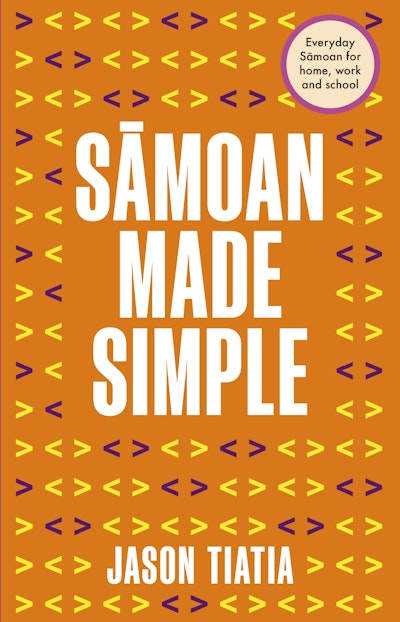
Sāmoan Made Simple

A mainstream, accessible guide to learning the Samoan language, for everyone.

Read more

Mata‘itusi o le Gagana Sāmoa — Sāmoan Alphabet and Letters (Page 20)

Examples of Short and Long Vowels (Page 23)

Veape Moelua — Vowel Pairs/Diphthongs (Page 24)

Double Vowel Sounds Word List (Page 25)

Konesane — Consonants (Page 26)

Komaliliu — Glottal Stop (Page 27)

Sāmoan Alphabet (Page 28)

Sāmoan Alphabet Song (Page 28)

Lisi o ‘Upu — Word List (Page 29)

Lisi o ‘Upu — Word List (Page 30)

Pronunciation: ‘T’ Style & ‘K’ Style (Page 33)

‘Upu Fa‘afeiloa‘i — Basic Greetings (Page 36)

Yes, No and I Don’t Know (Page 37)

Respectful Terms (Page 38)

Helpful Phrases To Use When You Don’t Understand (Page 38)

Asking How Someone Is (Page 39)

‘O o‘u lagona — My Feelings (Page 40)

Using ‘Fia’ (Page 41)

Numera — Numbers (Page 47)

Fuālā‘au‘aina — Fruit (Page 51)

Talanoaga — Dialogue (Page 56)

Sōānauna — Adjectives (Page 81)

Aso o le Vaiaso — Days of the Week (Page 102)

Aso o le Vaiaso — Days of the Week Song/Rap (Page 105)

Māsina — Months (Page 107)

Tau o le Tausaga — Seasons of the Year (Page 129)

Head, Shoulders, Knees and Toes Song (Page 137)

I le Ā‘oga — At School (Part 1) (Pages 144-145)

I le Ā‘oga — At School (Part 2) (Page 145)

I le Ā‘oga — At School (Part 3) (Page 145)

Asking and Telling the Time (Page 151)

Fa‘atonuga Faigofie — Simple Commands (Part 1) (Page 163)

Fa‘atonuga Faigofie — Simple Commands (Part 2) (Page 164)

House and Parts of the Home (Page 171)

Rooms of a House (Page 172)

O lo‘u ‘Āiga — My Family (Page 182)

Talanoaga — Dialogue: Vito (Page 184)

Talanoaga — Dialogue: Vita (Page 184)

Talanoaga — Dialogue: Ramona & Romeo (Page 186)

‘O fea e te nofo ai? — Where do you live? (Page 187)

Talanoaga — Dialogue: Sara & Sio (Page 198)

How to Ask Something (Page 201)

Tatalo Mea ‘ai — Prayer for Food (Page 203)

Formal Language — Levels of Fa‘asāmoa (Page 205)

Vala‘au 1 (Beginner) (Page 205)

Vala‘au 2 (Intermediate) (Page 206)

Vala‘au 3 (Expert) (Page 206)

Talanoaga — Dialogue: Jason & Amanika (Page 212)

Lisi o ‘Upu — Word List: Simple commands or instructions (Page 212)

Talanoaga — Dialogue: Papa & Nika (Ideal) (Page 214)

Talanoaga — Dialogue: Papa & Nika (Likely) (Page 214)

Sports and Games (Page 218)

Talanoaga — Dialogue: Romeo & Ramona (Page 220)

Words of Encouragement (Part 1) (Page 220)

Words of Encouragement (Part 2) (Page 221)

Words of Encouragement (Part 3) (Page 221)

Words of Encouragement (Part 4) (Page 222)

Sports Equipment and Terms (Page 223)

Talanoaga — Dialogue: Junior & Jason (Page 226)

Talanoaga — Dialogue: Jason & Aunty (Page 236)

Travel (Page 236)

Talanoaga — Dialogue: Sara & Sio (Page 238)

Travel (Page 238)

Talanoaga — Dialogue: Lili‘a & Migivao (Page 257)