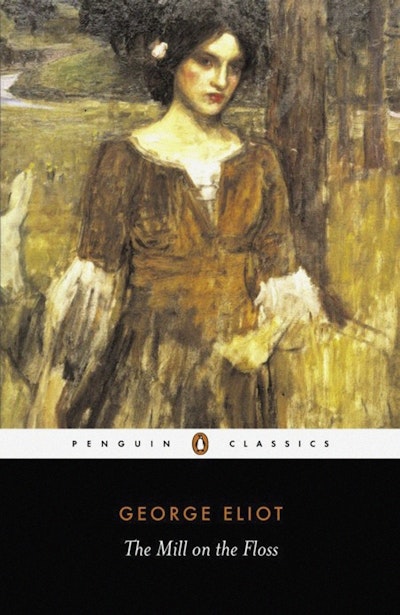
\"God gave her to me because you turned your back upon her, and He looks upon her as mine: you've no right to her!\"
Wrongly accused of theft and exiled from a religious community many years before, the embittered weaver Silas Marner lives alone in Raveloe, living only for work and his precious hoard of money. But when his money is stolen and an orphaned child finds her way into his house, Silas is given the chance to transform his life. His fate, and that of the little girl he adopts, is entwined with Godfrey Cass, son of the village Squire, who, like Silas, is trapped by his past. Silas Marner, George Eliot's favourite of her novels, combines humour, rich symbolism and pointed social criticism to create an unsentimental but affectionate portrait of rural life.
George Eliot was born Mary Anne Evans in Chilvers Coton, England in 1819 on an estate managed by her father. When her mother did she left school to run the household, continuing her education alone in the estate’s library. She was multi-lingual and steeped in classical literature by the time a series of her essays and translations led to an invitation to London to edit the prestigious Westminster Review—anonymously, for fear a female editor would put off readers. When nearly 40 she published the story collection Scenes of Clerical Life, under the pseudonym George Eliot, partly because she was living with a married man, radical publisher George Henry Lewes, and feared being shunned by the public. Bu tin 1849 her fist novel Adam Bede, with its startling realism and psychologically astute characterizations, caused a sensation—and prompted an imposter to claim authorship. Evans revealed herself and was indeed ostracized, although less so with each successful new book, from The Mill on the Floss to Silas Marner and Middlemarch. After 25 years together Lewes died and, still grieving, she married their banker, a man 20 years her junior. She died shortly thereafter in 1880.